Commercial Loan Types Explained
Choosing the Right Financing Tool
“What kind of rate can I get on something like this?”
That’s usually the first question a borrower asks. And we can always give a range.
But here’s the reality in 2026: the rate matters a lot less than which loan type you qualify for — and whether that loan structure actually works with today’s cap rates, leverage requirements, and DSCR rules.
Asking “what kind of commercial loan should I get?” is like asking what tool you need before you know what you’re building. The answer depends on what you’re doing today and where you want to go tomorrow.
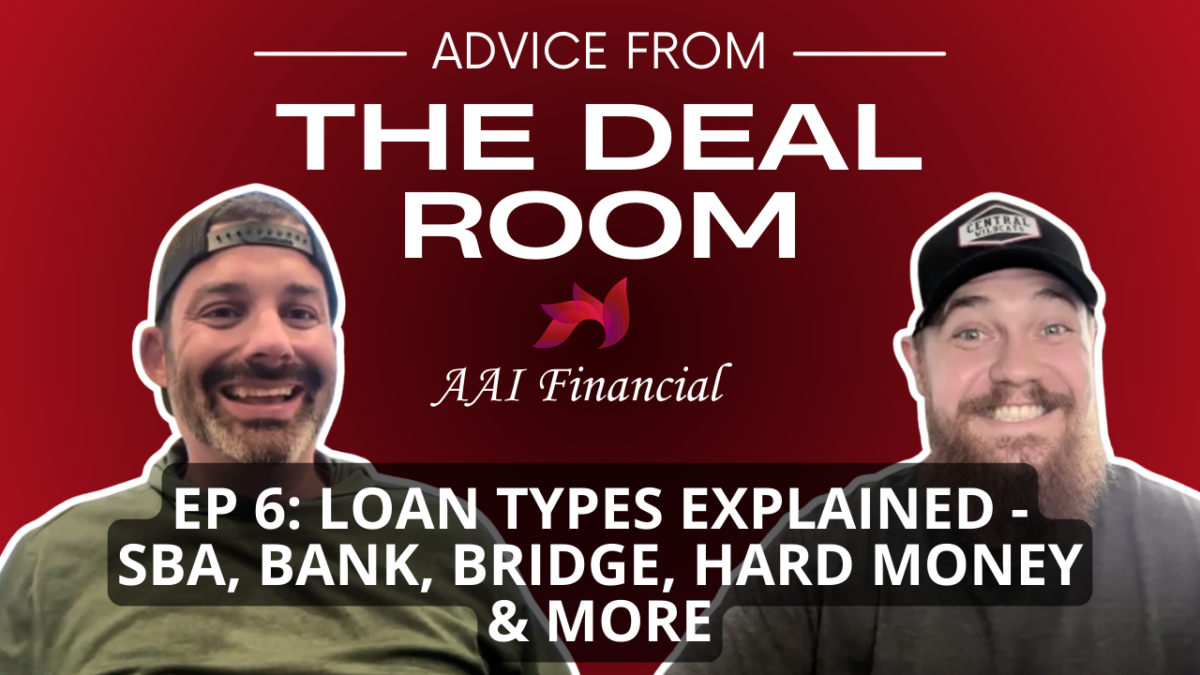
Episode 6 of Advice from the Deal Room walks through the major commercial loan types — when they work, when they don’t, and what borrowers should watch for before choosing one.
The 2026 Leverage Reality
Before diving into loan types, there’s a market reality borrowers need to understand.
When cap rates are lower than interest rates, lenders often cannot underwrite high loan-to-value deals without the property failing to cash flow.
Because of that, deals that once worked at 20–25% down are now often requiring 35–40%+ equity in many markets.
This isn’t lenders being difficult. It’s simple math driven by DSCR requirements.
The loan you want and the loan that works for your deal are not always the same thing. Bridging that gap is where good loan structuring matters.
Recourse vs. Non-Recourse: The First Decision
Before choosing a loan type, borrowers should understand one fundamental concept.
Recourse loans require a personal guarantee. If the loan defaults, the lender can pursue other personal assets, including a primary residence. Most bank, credit union, and SBA loans are recourse.
Non-recourse loans limit liability to the property itself, except for “bad boy” carve-outs like fraud or misrepresentation. Agency loans and CMBS financing are typically non-recourse.
Non-recourse loans usually come with lower leverage. Loan-to-value often falls in the 65–75% range, sometimes higher for strong multifamily deals.
SBA 7(a): High Leverage With Important Rules
SBA 7(a) loans can be one of the most powerful financing tools when they fit the deal.
They work especially well for:
• Business acquisitions
• Hotels and gas stations
• Owner-occupied commercial real estate
• Borrowers who need lenders to consider projected income
Key features include:
• Up to 90% leverage in some cases
• Floating interest rates tied to prime
• $5M cap on the SBA guarantee portion
• Requirement that the borrower occupy at least 51% of the property
One important watch-out: if there’s a collateral shortfall, the SBA may place a lien on the borrower’s primary residence.
SBA 504: Fixed Rates With a Unique Structure
SBA 504 loans operate very differently from 7(a).
They use a two-loan structure:
• Bank loan covering 50%
• SBA loan covering up to 40%
• Borrower equity of at least 10%
The SBA portion carries a long-term fixed rate, typically with a 25-year term.
Other advantages include:
• No lien on the borrower’s primary residence
• Eligibility for the SBA Green Program, allowing larger loan limits for energy improvements
• Financing for real estate and equipment
However, the process is slower because it requires approval from both the bank and the SBA through a CDC.
Conventional Loans: The Most Common Option
Traditional bank and credit union loans remain the backbone of commercial lending.
They are commonly used for:
• Property purchases
• Refinances
• Construction loans
• Operating lines of credit
Typical parameters include:
• Around 75% LTV for investment properties
• Up to 80% for multifamily in some cases
• DSCR minimums around 1.20–1.25
However, due to today’s rate environment, many deals that previously worked at lower down payments now require significantly more equity.
Another important tool within conventional lending is the business line of credit. Many businesses wait until they need one to apply, but lenders prefer to approve them when the business is financially strong.
Agency Loans: Long-Term Financing for Stabilized Assets
Agency loans — including Fannie Mae, Freddie Mac, and HUD financing — are designed for long-term property owners.
Common features include:
• Non-recourse structure
• Long-term fixed rates
• Optional interest-only periods
• Assumable loans when properties are sold
Fannie and Freddie primarily focus on multifamily properties, while HUD loans offer extremely long terms — sometimes up to 35 years fixed.
These loans typically carry prepayment penalties, which means they work best for investors planning to hold properties long term.
CMBS Loans: Capital Market Financing
CMBS loans are another form of non-recourse commercial financing.
They are commonly used for:
• Hotels
• Industrial properties
• Large office assets
Loan minimums often start around $1 million, and rates are usually tied to Treasury yields.
One unique feature is that CMBS loans are also assumable, meaning buyers can take over the loan if the property is sold.
Bridge Loans and Hard Money: Timing Tools
Bridge loans and hard money financing are often misunderstood.
They are not necessarily emergency funding — they are timing tools.
Hard money loans can close in as little as five business days, which can be valuable when acting as a cash buyer creates negotiating leverage.
Bridge loans typically offer:
• Short-term financing (1–3 years)
• Funding for renovations or stabilization
• A path to refinance into permanent financing later
Rates are higher than conventional loans, but the speed and flexibility often make them worthwhile for value-add deals.
Loan Types Change as Your Portfolio Evolves
One of the most important things borrowers should understand about commercial lending is that loan types evolve over time.
A borrower might:
• Use an SBA loan to acquire a business property
• Refinance into a conventional loan once equity grows
• Use bridge financing to stabilize a property
• Move into agency financing for long-term holding
Commercial financing is rarely a one-time decision. It’s a progression.
Frequently Asked Questions
What Is the Minimum Commercial Loan Amount?
Conventional commercial loans often start around $250,000 to $500,000, though many lenders prefer larger deals.
CMBS loans typically require $1M or more, while SBA loans can range from under $100K up to $5M on the guaranteed portion.
Can SBA Loans Be Used for Rental Investment Property?
Generally, no.
SBA programs require owner-occupancy of at least 51% of the property. Pure rental investments usually do not qualify.
What’s the Difference Between Bridge Loans and Hard Money?
Both are short-term financing options.
Hard money loans are typically faster, shorter term, and higher rate, often used for distressed or time-sensitive deals.
Bridge loans generally have longer terms and more structure, helping borrowers transition into permanent financing.
Should I Wait for Rates to Drop Before Buying?
Every deal is different, but waiting for rates to fall often means competing with everyone else who waited.
Strong deals exist in every rate environment. What changes is loan structure and equity requirements, not whether good opportunities exist.
Deal Room Takeaways
Interest rates matter — but the loan structure matters more.
Understanding how different commercial loan types work allows borrowers to choose the right financing tool for their deal, their timeline, and their long-term investment strategy.
Let’s Figure Out the Right Tool for Your Deal
The best loan is the one that fits your property, your cash flow, and your long-term plan.
Choosing the right financing structure today can make the next deal easier tomorrow.
Working on a deal and want a second set of eyes before you go to a lender? That’s exactly what we do. No cost for the conversation. Contact Us!
Let's talk.
We are knowledgeable, easy to talk to, and give free advice.
Please contact us to see how we can work together.
Or email us.